
 Data analysis uncovers variability in vaccine safety results across algorithms
Different case identification algorithms can significantly impact the reported incidence rates of outcomes related to pneumococcal vaccine safety. Summary Background Table 1. Incidence rates of cardiac and cerebrovascular outcomes in the target cohort, by sensitive and specific algorithms. Outcome Target cohort Sensitive algorithm Specific algorithm Rate from specific algorithm / rate from sensitive algorithm Rate per 100,000 person-years 95% CI 95% CI Rate per 100,000 person-years 95% CI 95% CI Lower Upper Lower Upper All cohort members 39,919,149 39,919,149 Cardiac and cerebrovascular outcomes Acute myocardial infarction 228.1 227.3 229.0 192.2 191.4 193.0 0.84 Cardiomyopathies and acute cardiac 200.4 199.6 201.2 174.3 173.6 175.1 0.87 Conduction disorders and arrhythmias 895.2 893.4 896.9 741.0 739.4 742.6 0.83 Coronary artery disease and angina 643.9 642.5 645.4 585.4 584.0 586.9 0.91 Heart failure 420.5 419.3 421.7 350.2 349.1 351.3 0.83 Kawasaki disease 2.1 2.1 2.2 0.1 0.1 0.2 0.05 Stroke 212.6 211.8 213.5 189.8 189.1 190.6 0.89 Transient ischemic event 230.9 230.0 231.8 168.6 167.8 169.3 0.73 Thrombotic disorders, including venous 490.9 489.7 492.2 456.3 455.0 457.5 0.93 Key takeaways
Domain(s): maternal-child health, CV-diabetes
Large health insurance claims databases can be leveraged to estimate rates of rare safety outcomes using algorithms consisting of diagnosis, procedure, and medication codes. These algorithms are subject to error. Using two algorithms for each outcome, we measured rates of rare outcomes that could be used to contextualize adverse events among people receiving pneumococcal vaccines in clinical trials or clinical practice. We also assessed the influence of algorithm choice on the rates of the outcomes.
Methods
We used closed administrative medical and pharmacy claims in the Healthcare Integrated Research Database (HIRD®) to construct a broad cohort of individuals less than 100 years old (i.e., the target cohort) and a trial-similar cohort of individuals resembling those potentially eligible for a vaccine clinical trial. We stratified by age and sex and used specific and sensitive algorithms to estimate rates of 39 outcomes including cardiac/cerebrovascular, metabolic, allergic/autoimmune, neurological, and hematologic outcomes. Specific algorithms intended to reduce false positive errors, while sensitive algorithms intended to reduce false negative errors, thereby providing lower and upper bounds for the "true" rates.
Results
We followed approximately 40 million individuals in the target cohort for an average of 3 years. Of 39 outcomes, 14 (36%) had a rate from the specific algorithm that was less than half the rate from the sensitive algorithm. Rates of cardiac/cerebrovascular outcomes were most consistent (average ratio of rates from specific algorithms compared to rates from sensitive algorithms = 0.76). For example, the estimated rate of thrombotic disorders was 456.3 cases per 100,000 person-years based on the specific algorithm versus 490.9 cases per 100,000 person-years based on the sensitive algorithm (Table 1). In contract, the rates of neurological and hematologic outcomes were the least consistent (average ratio of rates = 0.33 and 0.36, respectively).
Abbreviations: CI=confidence interval
inflammation
thromboembolism
Figure 1. Ratios of rates estimated from specific algorithms compared to rats estimated from sensitive algorithms in the target cohort. For each category of outcomes (cardiovascular/cerebrovascular, metabolic, allergic/autoimmune, neurological, and hematologic), the overall ratio indicated by black bars is the mean of the ratios for all outcomes in the category.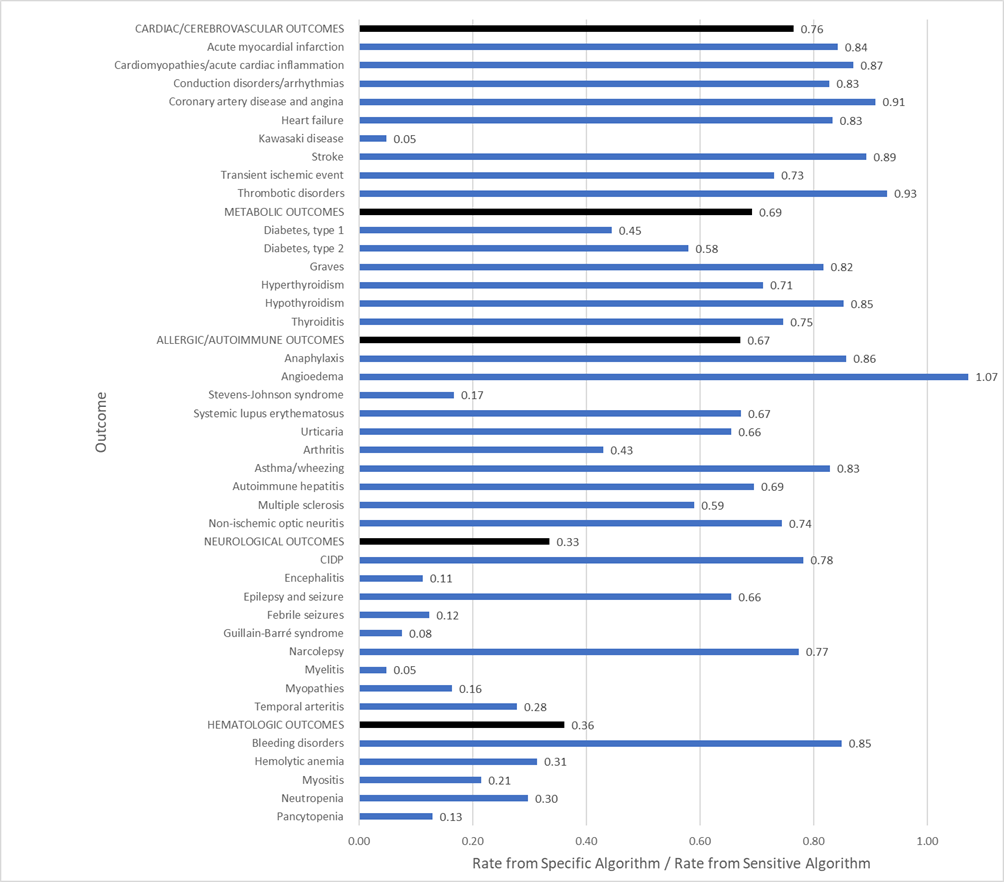
Abbreviations: CIDP = chronic inflammatory demyelinating polyradiculoneuropathy
Rate ratios closer to 1 indicate the algorithms produced similar rates of the outcome, and thus indicate less variation between the specific and sensitive algorithms. Rate ratios closer to 0 indicate greater variation between the two algorithms and very different outcome rates.
Carelon Research project team: Christopher L. Crowe, Stephan Lanes, Haechung Chug*
*Carelon Research associate at the time of the study.
For more information on a specific study or to connect with the Actionable Insights Committee,
contact us at [email protected].
Dissemination and sharing of the Newsletter is limited to Elevance Health and its subsidiaries, and included findings and implications are for Elevance Health and its affiliates’ internal use only.
Lorem ipsum dolor sit amet, consectetur adipisicing elit, sed do eiusmod tempor incididunt ut labore et dolore magna aliqua. Ut enim ad minim veniam, quis nostrud exercitation ullamco laboris nisi ut.

"Et harum quidem rerum facilis est et expedita distinctio!"

"Nam libero tempore, cum soluta nobis est eligendi."

"Temporibus autem quibusdam et aut officiis debitis!"